Peru Free Library Family Program brings Iditarod musher, her dog, and sled to town
Peru Gazette photo
Karen Land -Peru Gazette photo
Karen Land – Peru Gazette photo
By John T Ryan
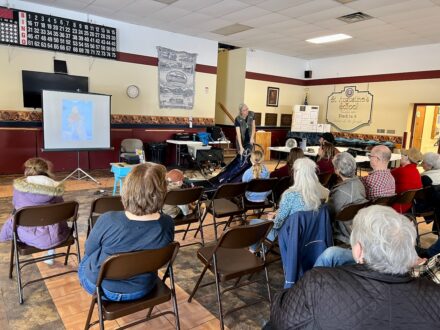
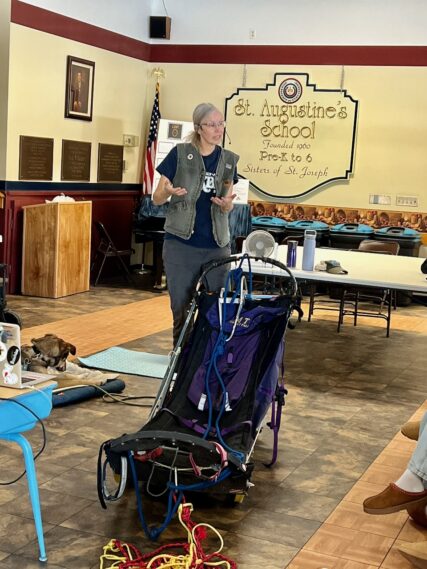
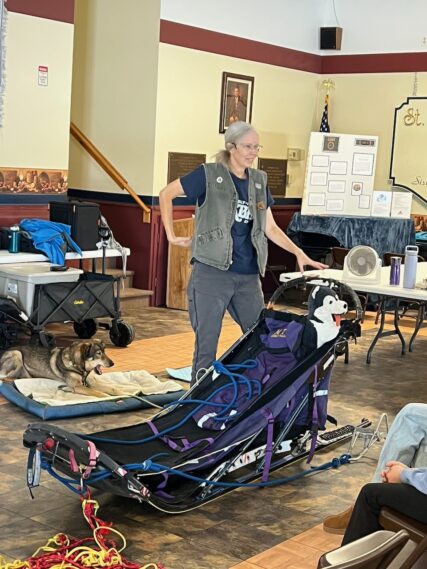
Peru – “Gee” and “Haw.” Those are the commands mushers use to tell their sled dogs to turn right and left. Until March 7, many local families and kids had never heard those words—at least, not until Karen Land brought her exciting world of sled dogs to a Peru Free Library Family Program at St. Augustine’s Parish Center. Land had everyone, from the youngest children to their parents, captivated with her thrilling stories, gear, and, of course, her friendly Alaskan Husky Sophie, who lay calmly nearby as she spoke. She’s been sharing her adventures at hundreds of libraries and schools since 2004, after competing in three consecutive Alaska Iditarod races, the nearly 1,000-mile trek from Anchorage to Nome.
Land explained that Alaska’s indigenous people were the first to develop these amazing mixed-breed sled dogs. She told the audience, “A Greyhound and German Short-Haired Terrier make the perfect combination!” She emphasized that sled dogs aren’t bred for looks—they need to be big, furry, strong, and, most importantly, friendly enough to work together as a team. Just imagine: at the start of the race, there are at least 12 dogs pulling the sled, and Karen raced with 16! By the end, mushers must finish with at least five dogs still running.
Kids and parents alike were amazed to learn about the costs and challenges of dog sledding. Land explained that she spent about $30,000 each year she raced—much of it to feed her hardworking dogs, who each eat up to 12,000 calories (that’s 7 to 9 pounds of food!) every single day. She even brought along some of the 2,000 tiny booties she needed to protect her dogs’ paws from sharp ice. The Iditarod is a true adventure: it can last anywhere from 8 to 15 days, with mushers and their dogs braving freezing temperatures, blizzards, and powerful winds. Land described moments when she had to trust her dogs to guide the way through whiteouts. The race has three mandatory stops for rest and food, and at each of the 23 checkpoints, veterinarians make sure the dogs are healthy and happy.
Rising world temperatures have impacted the race. Insufficient snow in 2015, 2017, and 2025 forced organizers to relocate the race 400 miles north from Fairbanks to Nome. Other years, it’s been run in segments, bypassing areas without snow or ice on mountains and bodies of water. Land said some small villages close to the Bering Sea are having to relocate inland.
Nevertheless, people are finding new ways to enjoy sled dog sports, even when there’s not enough snow. Karen told the kids about “dry-land mushing,” where mushers race using mountain bikes and scooters instead of sleds! It’s become so popular that the International Federation of Sleddog Sports now recognizes dry-land mushing as an official sport.
If you ever get a chance to hear Karen Land speak, take advantage of the opportunity. Thank you to librarian Stacey Bousquet and Peru Free Library for bringing her to our little community.
Posted: March 16th, 2026 under Adirondack Region News, Community Events, Education News, General News, Northern NY News, Peru Library News, Peru News, Youth News.