Malone Middle School Students Grow Food and Academic Confidence Through Innovative Classroom Partnership
Screenshot
North Country teaching team’s “Going Green” initiative, supported by The Heart Network’s CHSC program, integrates gardening and food production across the curriculum
May 21, 2026 – Malone, NY — At Malone Central School District, middle schoolers are growing lettuce under LED lights, tending Swiss chard on an aeroponic tower, feeding bullhead fish in an aquaponic tank, and planting apple trees on school grounds. It’s all part of “Going Green,” an interdisciplinary initiative led by a seven-member teaching team called Team Innovate, in partnership with The Heart Network’s Creating Healthy Schools and Communities (CHSC) program.
Funded by the New York State Department of Health, CHSC works to increase access to healthy food and physical activity in Franklin County schools. Over the course of the current grant cycle, the program has invested in hydroponic, aeroponic, aquaponic, and terraponic grow systems for Team Innovate’s classrooms, along with raised garden beds, grow lights, seeds, and supplies. This year’s investments included new hydroponic units, full-spectrum grow lights, seed potatoes for a bucket-growing project, a McIntosh apple tree, and materials for cedar raised beds. Matt’s Hardwoods supplied the rough-cut lumber at a reduced rate. The raised bed was built by students. Michael Botto and English teacher Dan Tusa, along with four students, constructed the new 7’x4’ bed in a 40-minute class period.
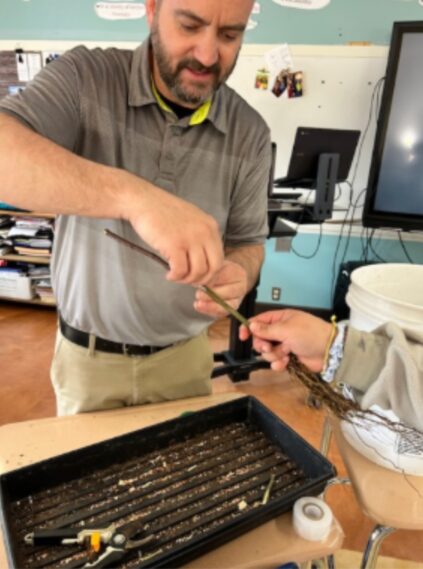
Dan Tusa, an English Language Arts teacher with more than 25 years of experience, coordinates the Going Green initiative alongside colleagues who teach science, social studies, math, tech/art, and special education. Together, they have woven food production and environmental sustainability into core instruction across subject areas. Science students study plant biology and environmental systems. Math classes track and analyze growth data. ELA students document the process and reflect on the role of technology in food production. The team has even explored fruit tree grafting and, earlier in the program, collaborated with MIT engineers to build a “Food Computer” that allowed students to program and monitor growing conditions.
“Students don’t need land or expensive equipment, just a small space with sunlight, along with water and basic nutrients,” Tusa said. “It connects directly to our ‘Going Green’ focus, reinforces concepts in plant science and sustainability, and empowers students with a practical skill they can replicate at home.”
Rather than replacing core instruction, Team Innovate builds short, purposeful windows into the daily schedule for students to rotate through project tasks: planting, monitoring growth, collecting data, maintaining systems, and reflecting on outcomes. Teachers report clear improvements in student participation, motivation, and behavior, particularly among students who don’t always thrive in traditional classroom settings.
“Even tasks like hauling water, shoveling soil, and cleaning fish tanks have led to increased academic progress, as the hands-on engagement builds responsibility, reinforces concepts, and motivates students to invest more deeply in their learning across all classes,” Tusa said.
The program has also built connections between the school and the wider community. Team Innovate has partnered with the DEC farm in Saratoga, the greenhouse at SUNY Potsdam, and the Chateaugay Fish Hatchery, where students participate in annual fish stocking at Lake Meacham. These experiences have introduced students to career pathways in sustainable agriculture, environmental science, and engineering.
This year, The Heart Network also worked with Malone CSD to update the district’s local wellness policy, reinforcing the school’s commitment to student health and nutrition at the institutional level.
The program continues to expand, with support from school administration and families. This spring, students have been repotting onions, peppers, tomatoes, and zinnias, and the team is planning a student-organized plant sale.
“It has brought a renewed sense of purpose, creativity, and collaboration to my teaching,” Tusa said. “Rather than slowing down, this work continues to open new possibilities, and each year builds on the last.”
About The Heart Network’s CHSC Program Funded by the New York State Department of Health, the CHSC program works to increase access to healthy food and physical activity in Franklin County schools. The program is administered by the North Country Healthy Heart Network. For more information, visit www.heartnetwork.org or contact apatraw@heartnetwork.org. The program is administered by the North Country Healthy Heart Network. For more information, visit www.heartnetwork.org or contact apatraw@heartnetwork.org.
Posted: May 22nd, 2026 under Agricultural News, Community Events, Education News, General News, Heathcare News, Northern NY News, Statewide News.