
DiNapoli: State tuition assistance program not keeping up with inflation, tuition costs

77,000 Fewer Undergrad Students Receiving Help Compared to 2008
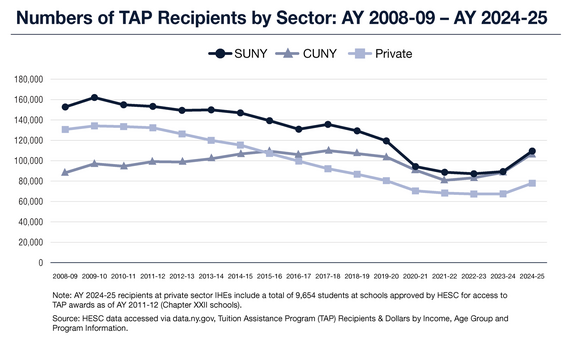
A new report from State Comptroller Thomas P. DiNapoli finds that New York’s Tuition Assistance Program (TAP), the state’s primary need-based grant program for college students, has not kept pace with inflation or rising tuition costs since the 2008-09 academic year (AY) and that undergraduate TAP recipients dropped by 77,000 (21%), with steep declines among two-year programs (45%), private-sector schools (40%), and lowest income households (38%).
“TAP has helped generations of New Yorkers attend college, but it’s falling behind the realities of today’s costs,” DiNapoli said. “Updating award criteria so that TAP continues to be a useful support for families is needed to help New York retain talent and ensure students have the resources they need to succeed.”
The decline in recipients since 2008 is partially related to the fall in high school graduates and the drop in postsecondary enrollments, but utilization of TAP was already dropping at a greater pace than for resident enrollment in many sectors, before rebounding in AY 2024-25.
Between AYs 2008-09 and 2024-25, the average award increased only 21% to $2,643, while inflation rose 44% during this time. Over the same period, State University of New York (SUNY) and the City University of New York (CUNY) tuition grew more than three times faster.
Only students from households earning $7,000 or less qualified for the maximum annual TAP award of $5,665 in AY 2025-26, an income ceiling that has not changed for 30 years. Students receiving maximum awards in AY 2024-25 decreased 38% since AY 2008-09.
Limited Support for Many Recipients
TAP is a more meaningful source of support for students at public institutions, where tuition tends to be more affordable. For these students, average awards cover 36% to 42% of tuition depending on system and level of degree. The average TAP award for students attending private sector institutions covers just 6.5% of the average four-year non-profit school tuition. TAP may not be used for non-tuition costs, which can represent significant expenses.
Expanding TAP Access
Recent state actions to expand eligibility for TAP have coincided with the highest number of TAP recipients in AY 2024-25 since AY 2019-20. New York has provided new assistance for certain students to pursue postsecondary education and retraining for career shifts, and has increased income limits for students to qualify for an award. In 2024-25 alone, there was a 20% increase in the number of total TAP recipients from the prior year. The gains across different groups demonstrate the impact of broadening access for part-time study and non-degree or certificate programs along with expanding household income ceilings for eligibility.
These actions support institutes of higher education that have been expanding their enrollments with historically under-represented students, including those who are older and independent. DiNapoli said updating criteria that determine sizes of TAP awards and consideration of TAP’s use for non-tuition purposes are options policymakers can consider for providing support that New York students need to pursue postsecondary education here, enabling them to realize economic benefits for themselves, their families and the state.
Analysis
Is New York State’s Tuition Assistance Program Meeting Need?
Related Reports
Higher Education in New York: Evaluating Competitiveness and Identifying Challenges
Posted: February 17th, 2026 under Education News, Northern NY News, Social Issues, State Government News, State Legislator News, Statewide News.