Hochul signs bill mandating new NY drivers be tested on cyclist and pedestrian safety awareness
Posted: July 16th, 2022 under Law Enforcement News, State Government News.
Comments: none
A free community news service for Peru, NY
Posted: July 16th, 2022 under Law Enforcement News, State Government News.
Comments: none
Posted: July 16th, 2022 under County Government News, Education News, Northern NY News, Peru/Regional History, Regional NY-VT News.
Comments: none
Posted: July 16th, 2022 under Heathcare News, National News.
Comments: none
New Yorkers urged to remain vigilant when building campfires
Posted: July 16th, 2022 under Adirondack Region News, Environmental News, Northern NY News.
Comments: none
Legislation signed July 15 brings $50 fines for violations
Posted: July 16th, 2022 under Heathcare News, Peru/Regional History, State Government News.
Comments: none
State tax receipts totaled $34.4 billion through the first quarter of State Fiscal Year 2022-23, exceeding the Division of the Budget’s (DOB) Enacted Budget Financial Plan forecast by $1.7 billion, according to the monthly State Cash Report released by State Comptroller Thomas P. DiNapoli.
“The revenue news for New York was positive for the first quarter,” DiNapoli said. “However, economic headwinds are increasing, and may alter the trajectory for the remainder of the fiscal year. Bolstering rainy day reserve funds on or ahead of the schedule included in the Enacted Budget Financial Plan should be a priority.”
State Tax Collections Through June 30
(in millions of dollars)
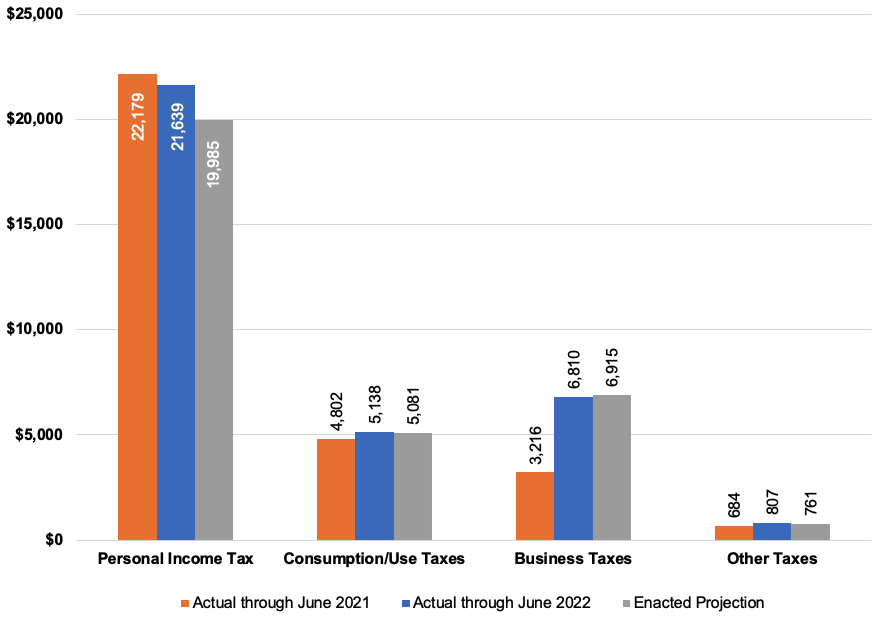
Personal income tax (PIT) receipts totaled $21.6 billion and were $1.7 billion above DOB’s financial plan projections through the first quarter. However, PIT receipts were $540.5 million lower than the same period in SFY 2021-22, reflecting, in part, the effects of the Pass-Through Entity Tax (PTET), which allows certain taxpayers to make business tax payments rather than personal income tax payments. Read more »
Posted: July 15th, 2022 under Business News, State Government News.
Comments: none
Posted: July 15th, 2022 under Heathcare News, National News, Peru/Regional History.
Comments: none
New York State Comptroller Thomas P. DiNapoli today announced the sentencing of Leslie Schwinzer, of Knoxville, Tennessee, for stealing pension checks that had been issued to her deceased mother. Schwinzer, 46, was sentenced on July 14, 2022 to pay over $56,000 in restitution and serve 8 months home detention and 2 years’ probation before the Honorable Thomas A. Varlan in United States District Court for the Eastern District of Tennessee at Knoxville.
“Leslie Schwinzer lied about her mother’s death in order to collect her pension checks and steal from New York state’s retirement system,” DiNapoli said. “Thanks to my partnership with the U.S. Attorney’s Office for the Eastern District of Tennessee, we uncovered this fraud, and Ms. Schwinzer has now been held accountable for her crimes.”
On March 10, 2022, Schwinzer pleaded guilty to a charge of one count of wire fraud. She admitted that she failed to notify the New York State and Local Retirement System (NYSLRS) and Social Security Administration (SSA) that her mother had passed away on July 3, 2018. All related payments should have stopped after her mother’s death. Instead, Schwinzer received $92,222.55 in pension checks and Social Security payments into a joint account she held with her mother that she was not authorized to receive.
Schwinzer did not stop withdrawing the money from the account until a bank representative contacted her on December 19, 2019 to tell her that the bank had been informed of her mother’s passing. Schwinzer lied in response, stating: “No, she’s fine.”
SSA recovered the funds it had paid into the account after Schwinzer’s mother’s death.
This prosecution is the result of a joint investigation by the New York State Comptroller’s Office, the Social Security Administration Inspector General’s Office and the United States Attorney for the Eastern District of Tennessee.
Posted: July 15th, 2022 under Law Enforcement News, State Government News.
Comments: none
Posted: July 15th, 2022 under City News, Heathcare News, Northern NY News, State Government News, Upstate New York.
Comments: none
Out of 80 available beds, only 52 are occupied because they don’t have enough staff to care for the remaining 28.
Posted: July 15th, 2022 under County Government News, Heathcare News, Northern NY News, Peru/Regional History.
Comments: none
The New York State Department of Environmental Conservation (DEC) today announced that Beech Leaf Disease (BLD), which affects all species of beech trees, was identified in 35 counties in New York State to date. DEC began tracking BLD in 2018 after it was confirmed in Chautauqua County. Fourteen of the counties with BLD were confirmed in 2022, and more are likely to be identified.
“Many American beech trees are already heavily impacted by beech bark disease, but Beech Leaf Disease appears to be an even bigger threat,” said DEC Commissioner Basil Seggos. “The decline of beech in New York could have far-reaching consequences, including significant changes to the composition of our northern hardwood forests and the loss of a valuable food source for wildlife. Beech Leaf Disease affects all beech, so the impacts would also be felt in our urban forests where ornamental beech trees, including the popular copper beech cultivar, are widely used for landscaping and street trees.”
Much is still unknown about BLD, including how it spreads, but it can kill mature beech trees in six to 10 years and saplings in as little as two years. There is no known treatment for infected trees. BLD symptoms are associated with the nematode Litylenchus crenatae mccannii. It is unknown whether the nematode causes all of the damage, or if it is in association with another pathogen such as a virus, bacteria, or fungus.
DEC is working with the Cornell Plant Disease Diagnostic Clinic, the U.S. Department of Agriculture Forest Service, neighboring states, and New York’s Partnerships for Regional Invasive Species Management (PRISMs) to survey for new infections, track disease progression using long-term monitoring plots, and investigate the nematode’s role in the disease. More information is needed to develop an effective treatment.
DEC’s Forest Health Diagnostic Lab is experiencing a recent surge in requests for BLD diagnosis and treatment options as landowners begin to notice a rapid decline in the health of their beech trees. Most of the reports are from Suffolk and Westchester counties where BLD is widespread. DEC is asking the public to submit reports through NYimapInvasives (leaves DEC website) if they encounter a beech tree showing signs of BLD, especially for counties where BLD has not yet been confirmed.
The main symptom to look for on beech foliage is darkened striping between the veins, which is best seen when looking up through the canopy. Leaves with severe symptoms can be heavily banded and crinkled, with a thickened leathery texture.
At this time there are no specific recommendations for managing trees that are infected with BLD, however, DEC encourages the public to report potential BLD infections using iMapInvasives to help track the disease while research is ongoing.
For more information about beech leaf disease, visit DEC’s website. For more information on iMapInvasives, visit the NYimapInvasives website (leaves DEC website). For questions about potential tree pests or pathogens, email photos and a description to foresthealth@dec.ny.gov.
Posted: July 15th, 2022 under Environmental News.
Comments: none
The devastating number of job losses caused by the COVID-19 pandemic caused a significant increase in the number of residential customers owing money to their utility companies, with one in eight customers in arrears as of March 2022, according to a reportreleased today by State Comptroller Thomas P. DiNapoli. More than 1.2 million customers statewide owed $1.8 billion with customers from New York City and Long Island comprising 60% of those in arrears and 68% of the amount owed.
In the first quarter of 2022, the number of customers behind on their bills fell by about 50,000 to 1.2 million while the total amount owed grew to $1.8 billion, an increase of close to $1 billion from March 2020. The average amount customers owed over this period doubled from $768 in March 2020 to $1,467 in March 2022.
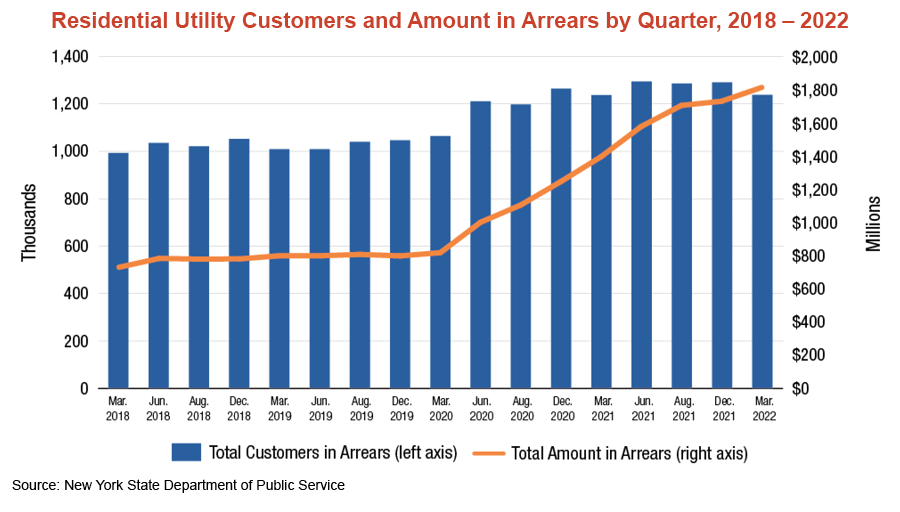
“The pandemic’s effects continue to be felt in multiple aspects of life, including the elevated number of New Yorkers who continue to have trouble paying their utility bills,” DiNapoli said. “Failure to pay these bills may result in service shutoffs, which increases economic stress on families and can damage local economies by reducing household spending, leading to job losses. State lawmakers and the Public Service Commission have acted to provide meaningful relief to low-income customers through the Utility Arrears Relief Program and the Phase 1 Arrears Reduction Program, and should continue to consider mechanisms to help utility customers that cannot pay their bills.”
DiNapoli’s report, includes:
Analysis
Economic and Policy Insights: Distribution of Utility Arrears in New York State
Posted: July 15th, 2022 under Heathcare News, Peru/Regional History, State Government News.
Comments: none
Clinton County Legislature News Release
July 14, 2022 – Plattsburgh, NY – Last evening the Clinton County Legislature made the extremely difficult decision to begin the process of selling the County Nursing Home. Clinton County operates one of the last county-owned nursing homes in New York State. Over time, it has become clear that despite the County’s best efforts, the Nursing Home has not been able to generate enough revenue to provide the resources the staff requires to provide the necessary high-quality care to the residents of the facility that they deserve.
“This decision was not an easy one, however after many months of deliberation and discussion, it became evident that this was the most prudent course of action,” said Mark Henry, Chairperson of the Clinton County Legislature (R-Area 3, Chazy.) “Providing our residents with quality, professional, medical and nursing services that enrich their lives has, and remains, of utmost of importance to the Clinton County Legislature. Further, we recognize that the continuous and selfless efforts of the almost 75 employees of the facility has contributed an immeasurable impact on not only the lives of the residents, but of our entire community. We remain dedicated to prioritizing their continued dedicated service to this facility and the Legislature is committed to enlisting an employer that prioritizes their longevity.”
The Clinton County Nursing Home is just one among many rural nursing homes that have been forced to evaluate its ownership and operation.[1] Almost 1,000 nursing homes have been forced to close since 2015 and most of these nursing homes operate in rural areas with less than 100 beds; Clinton County Nursing Home has the capacity to serve 80 residents.
“As the Chairman to the Human Services Committee, I have seen firsthand the critical role that this facility plays in our area,” said Francis Peryea, Chairperson of the Human Services Committee, Clinton County Legislature (R-Area 2, Altona.) “That is why the Legislature remains steadfast in seeking a buyer that will prioritize residents and employees and be a well-rounded fit for the community as a whole. At the end of the day, we want to support our residents and employees without causing an undue burden on our taxpayers. We remain committed to ensuring this facility remains open and sustainable.”
The County Nursing Home is under-utilized due to staffing shortages. It is licensed to care for 80 residents, but only 52 residents currently reside there because the County has not been able to fill over 50 vacant full and part-time positions. The Legislature will continue to financially support the staff of the Nursing Home throughout the transitional process and are prioritizing a buyer who will not only support this concept of wage sustainability, but is able to offer more flexibility and potentially higher wages to retain existing and attract new employees. There is a critical need for access to long-term care in our region, and the Legislature is convinced that this sale will improve that access. The Clinton County Legislature remains dedicated to supporting its aging population and its altruistic health care workforce.
Posted: July 15th, 2022 under Adirondack Region News, County Government News, General News, Heathcare News, Northern NY News, Peru/Regional History.
Comments: none
The total cost of overtime in 2021 reached an all-time high at more than $924 million, up 8.7% from 2020, covering roughly 19.95 million overtime hours worked, or an increase of 4.3%, according to a report released today by State Comptroller Thomas P. DiNapoli. Total overtime hours worked at state agencies have increased by 38% since 2012, while the number of employees has declined by more than 10% at ten major agencies.
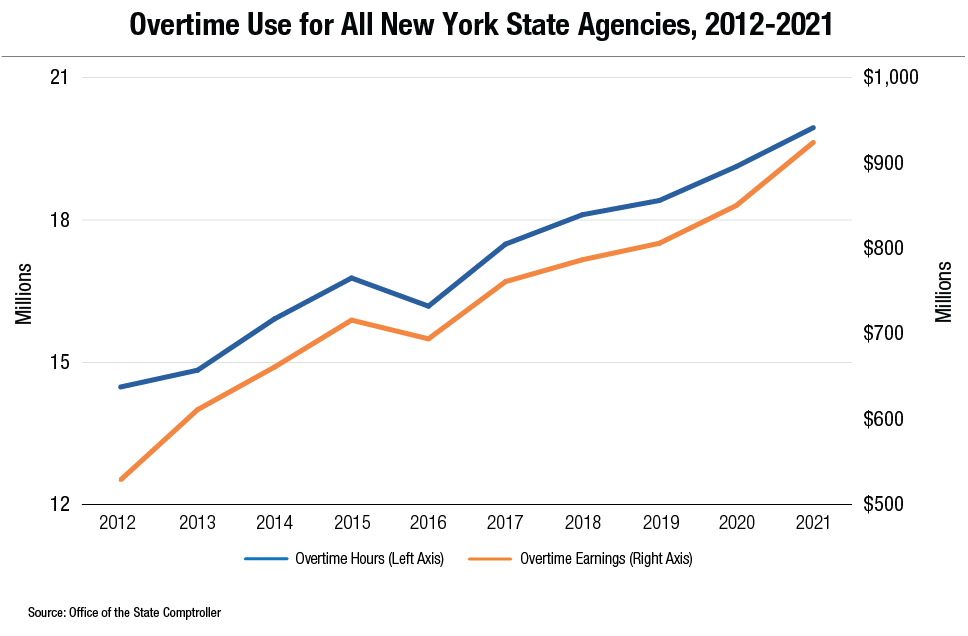
“As state government grappled with the impacts of the pandemic, overtime costs set a new record in 2021,” said DiNapoli. “While the pandemic does not appear to have prompted a ‘great resignation’ from the state workforce in 2020, new hiring stalled, and the workforce declined more sharply in 2021 than in the prior decade. The state needs to continue to attract and retain a range of diverse employees to be responsive to 21st Century needs, and to ensure that services are provided in a cost-effective manner without excessive use of overtime.”
Most of the state’s overtime in 2021 came from the Office for People with Developmental Disabilities (OPWDD), the Department of Corrections and Community Supervision (Corrections) and the Office of Mental Health (Mental Health). The three agencies accounted for 66% of the overtime hours and 62% of the overtime earnings logged by all state agencies in 2021. Overtime also rose significantly at the Office of Children and Family Services (OCFS) and the City University of New York (CUNY), where hours increased more than 25% and overtime earnings more than 45%.
Key Findings Related to Overtime in 2021
Posted: July 15th, 2022 under Law Enforcement News, Northern NY News, State Government News.
Comments: none
A white SUV was photographed and taken away by a tow truck around midnight on Friday.
Posted: July 15th, 2022 under Law Enforcement News, Northern NY News.
Comments: none
Posted: July 15th, 2022 under Environmental News, Lake Champlain News, Northern NY News.
Comments: none
Posted: July 15th, 2022 under Business News, City News.
Comments: none
Posted: July 15th, 2022 under Business News, State Government News.
Comments: none
Posted: July 15th, 2022 under Business News, Northern NY News, Peru/Regional History, Regional NY-VT News.
Comments: none
Posted: July 15th, 2022 under Heathcare News, National News, State Government News.
Comments: none
Posted: July 15th, 2022 under Education News, Northern NY News, Peru/Regional History.
Comments: none
Up to five years to implement design phase of the project
Posted: July 15th, 2022 under Highway Dept. News, Northern NY News, Peru/Regional History.
Comments: none
Sandstone near the Saranac River give Redford glass its distinct color
Posted: July 15th, 2022 under Business News, Northern NY News, Peru/Regional History.
Comments: none
Posted: July 14th, 2022 under County Government News, General News, Northern NY News, Peru/Regional History.
Comments: 1
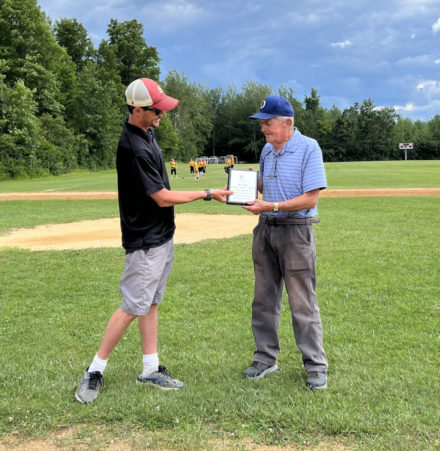
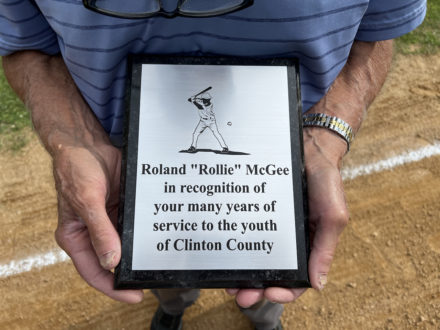
County Recreation Director Nick Arnold presents “Thank You” Plaque to Rollie McGee
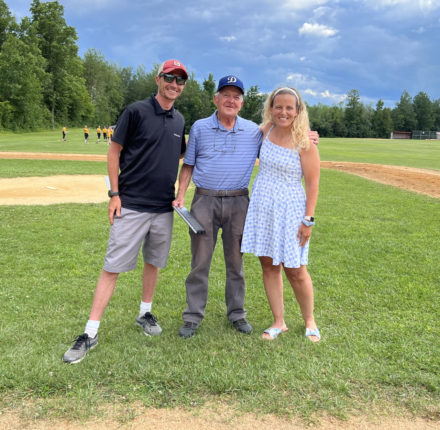
Terra Sisco, Clinton County Youth Bureau Supervisor congratulated Rollie
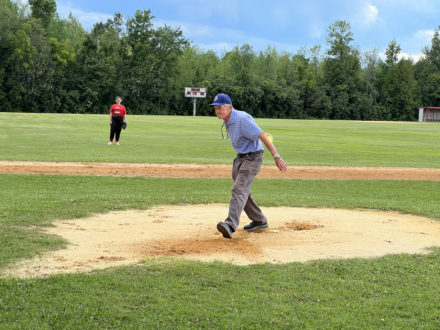
Rollie throws a beautiful strike just prior to the Beekmantown Pony League game.
By John T. Ryan
Beekmantown: Tuesday evening July 12th, before a Pony League game at the Beekmantown Recreation Park, the Clinton County Youth Bureau honored longtime Peru resident Roland “Rollie” McGee. Nick Arnold, Clinton County Recreation Director, presented a plaque to McGee. Arnold commented, “We wanted to thank Rollie for all his service to the county. He’s been coming to ball games for us for twenty-eight years, ensuring everything runs as it should. He doesn’t get paid a lot for doing it. But, he puts in a lot of time and effort. We just wanted to thank him and let him know his work doesn’t go unnoticed.”
McGee’s duties include ensuring the ball field is safe, watching the young umpires, teaching them if there’s something they don’t know, and making sure the coaches and fans are acting according to the rules. Arnold commented, “We don’t have fan problems when Rollie is here. He commands respect.”
A Peru native, Rollie McGee is a 1958 Peru High School graduate and a member of the Peru High School Sports Hall of Fame. A high school baseball star with a no-hitter to his credit, today he’s probably better known for his 50+ years as a baseball umpire. From 1993 until two years ago, McGee umpired Little League games throughout the region. Anyone who saw him in his uniform knew he took great pride in being an umpire. McGee explained, “I had three sets of uniforms. I sent them to the dry cleaners for cleaning and pressing. I also spit-polished my shoes. My philosophy was if you look and act like a professional, you are a professional.”
McGee learned spit-polishing in the U.S. Army, where he served for twenty-eight years, but still found time for umpiring. His special memories include umping international tournaments in Japan, Thailand, and Turkey. He recalled, “When the Army stationed me in Ankara, Turkey, I realized the kids on the nearby airbase didn’t have an organized league. So I helped the Air Force set up Little League.”
Roland “Rollie” McGee is worthy of recognition for his devotion to youth, baseball, following and teaching the game’s rules, and his professionalism.
Posted: July 14th, 2022 under Education News, Faces of Peru, General News, Sports News.
Comments: none