Little to seek re-election to state Senate – Sun Community News & Printing
Posted: May 18th, 2018 under State Legislator News.
Comments: none
A free community news service for Peru, NY

Posted: May 18th, 2018 under State Legislator News.
Comments: none
Source: Five weeks, five candidates: Who’s the frontrunner in Congress race? – Sun Community News & Printing
Posted: May 18th, 2018 under Congressional News.
Comments: none
Posted: May 18th, 2018 under Adirondack Region News, Environmental News.
Comments: none
Posted: May 18th, 2018 under Adirondack Region News, Environmental News.
Comments: none
Posted: May 17th, 2018 under State Government News.
Comments: none
The Town of Peru Town Board has scheduled a Workshop for Tuesday, May 29, 2018 at 6:00 PM. The purpose of the workshop will be to discuss The Sewer Upgrade. The Workshop will take place at The Peru Town Hall.
______________________
Dianne Miller
Town of Peru
Town Clerk
Posted: May 17th, 2018 under Town Board News, Water & Sewer Dept. News.
Comments: none
Total Ballots – 815
Budget Proposition #1 – Yes – 597, No – 204
Bus Proposition #2 – Yes – 617, No – 184
Capital Project Proposition #3 – Yes – 568, No – 235
Sarah Mitchell – 503
Steven Peters – 272
Kim Mayer – 214
Graham Niles – 140
Scott Thurber – 286
Posted: May 15th, 2018 under Education News, Peru News, Peru School News, Peru/Regional History.
Comments: none
By Marquee Moffett
On Tuesday, May 15th, voters in the Peru School district will select two individuals to serve on the school board. Five community members have stepped forward stating they are willing to volunteer their time and energy to serve in this capacity.
This year’s candidates are Kim Mayer, Sarah Mitchell, Graham Niles, Steve Peters, and Scott Thurber. Read on to learn about each candidate and see their responses to seven questions posed by the Peru Gazette.
Kim Mayer has high expectations for schools. Nine years ago, she and her family moved to the Peru School District and she has been very happy with that decision. With three children currently in Peru Junior and Senior High Schools, Kim’s family accesses a wide variety of the school’s programming, including the regular curriculum, CAP and AP programs, and the services of the special education department. An educator herself, Kim has spent more than 25 years working at CVES in the Special Education Division, the technology department, and as a Physical Education teacher. Kim has also volunteered her time to assist the district in several ways, including serving on the Tech Vision, Well-Bring, PSET, and Peru 2020 committees. Currently serving as President of the Peru CSD Board of Education, Kim believes her training as a facilitator, her skills as an active listener and effective communicator, and her broad technology knowledge base will be of benefit to the School Board.
Sarah Mitchell has lived in the Peru School district her entire life. Having attended Peru Nursery School, St. Augustine’s School, and Peru Jr./Sr. High School herself, Sarah is happy that her children are also attending Peru Schools. With one child attending Peru Elementary School and another child attending Peru Junior High, Sarah sees many opportunities for community members to help our schools and students achieve success. She has done extensive volunteer work for the district, including as an active member of Peru PTO and Peru Music Boosters. Sarah also works full time as an Advanced Critical Care EMT for CVPH covering the Peru and Keeseville Fire Districts. Having already created many positive relationships with school faculty, staff and administration, Sarah believes her high level of motivation, her creativity, and her strong organizational skills will be assets to the Peru CSD Board of Education.
Graham Niles is originally from the Brushton-Moira area. When he and his wife, a Peru native, started thinking about raising a family, they knew Peru would be the perfect place to do so and purchased a home here approximately 2 ½ years ago. Though Graham does not yet have school-age children, he looks forward to watching his daughters grow up in the Peru School system, starting with Pre-K in the fall of this year. Currently employed at the family-owned wealth management firm Niles Asset Management, Inc, Graham believes community involvement is an important part of both his work and his personal life. In his professional life, Graham has had extensive experience as a consultant on large, multi-million dollar budgets and in collaborating with people to solve problems and get things done. He believes these skills would be great assets to students and staff of our school district and hopes to bring them to the table as a member of the Peru CSD Board of Education.
Steve Peters is originally from Schenectady, NY and first came to the area as a student at SUNY Plattsburgh. While a student, Steve fell in love with the Adirondack Coast region and, later, when he and his wife were starting a family, they decided the Peru Schools fit their values perfectly. Steve and his family have lived in Peru for 10 years and now have two children attending Peru Elementary School. Currently the Village Administrator for the Village of Rouses Point, and before that as the Superintendent of Recreation for the City of Plattsburgh, Steve has 10 years of experience managing multi-million dollar public-sector budgets, public facilities, programs, and projects. In addition, Steve owns a side business, Adirondack Coast Events, through which he recently collaborated with the Peru PTO to donate the race timing for the Peru Pride 5k and Fun Run last month. Steve believes his ability to develop creative solutions to complex problems and his ability to envision and work toward goals will be beneficial to the Peru CSD Board of Education.
Scott Thurber has lived in Peru for approximately 16 years of his life. He attended Peru Schools from Kindergarten through 7th grade before his family moved to Plattsburgh and he changed schools. Scott has many fond memories of Peru Schools and was very happy to return to his childhood town three years ago. Together, Scott and his wife have five children. While four of them have already graduated high school, the youngest is currently a senior at Peru High School and will graduate this June. Since moving to Peru, Scott has volunteered to chaperone the prom and also worked for the Peru School District as a teacher’s aide during the 2015-2016 school year. Currently, Scott works as a full-time teaching assistant for the Beekmantown School District where he is responsible for the in-school suspension/structured study hall room for the Middle and High Schools. Scott believes his strong work ethic and his skills as a problem-solver, effective communicator, negotiator, and team member will be great assets to the Board of Education.
Now that you have learned a bit about each of the five candidates, read on to hear their answers to the questions posed by the Peru Gazette.
Q: Many people refer to school board seats as “thankless positions” because they seem to involve a lot of hard work and very little glory. What has motivated you to run for a school board seat?
Kim Mayer: When I first moved into the district, I attending the monthly BOE meetings and found myself at the microphone frequently sharing my opinions and concerns. I am a “put up or shut up” type of person and decided that if I disagreed with much of what I was hearing, I should step up to be part of the solution.
Sarah Mitchell: I want to be involved. I have involved myself in various organizations that support education (Peru Nursery School Board and Peru PTO) but I see this as an opportunity to do more and affect positive change for all students in our district.
Graham Niles: – I have heard this time and time again, but when I think about my children attending Peru, and the obstacles facing education and school finances over the next ten years, I believe I should be part of the solution rather than to sit idly by.
Steve Peters: I have decades of experience in budgeting, facility management, program creation, leadership, and policy creation. I understand what it takes to turn public liabilities into public assets and have many years of experience in doing so. I am not afraid to make difficult, data-driven decisions, which is what I believe Peru needs right now. I’ve been in the classroom as an instructor of many classes at SUNY Plattsburgh, which gives me a perspective that will help our educators. When you combine those experiences, being a school board member is a good fit.
Scott Thurber: I don’t feel the position as a school board member is thankless. I’m sure it will be a lot of hard work which I’m not afraid of. However, I disagree with the “no glory”. The glory is when we watch the products of our hard work as a district walk onto that stage to receive their diplomas and start their paths in this world. I was motivated to run for the board after attending several meetings over the past year and observing what I believe to be the lack of effective communication and complacency.
Q: If elected, what will be your top three priorities for the school district?
Kim Mayer: Safety is always the first priority in a school district. Our students also need to feel supported by staff; we need to provide for their academic needs, as well as their social-emotional needs. Another key issue for school boards is to create a long-term vision, mapping a course that provides the necessary opportunities students need to reach their full potential. This long-term vision must include the thoughts and experiences of the stakeholders of our diverse community. Increasing transparency in district decision-making and communication with all stakeholders is vital for success.
Sarah Mitchell: My top three priorities for the district would be strengthening communication between the school, parents, and community; ensuring our graduating seniors are academically and socially prepared for the rigors of college and the workforce; and balancing the fiscal needs of the district and taxpayers with the needs of our students.
Graham Niles: My top three priorities will be 1) to focus on education and to make sure that Peru Central is viewed as the best district in the north country, 2) making sure that tax increases do not burden our residents in the community, and 3) to make sure our students and staff are safe at all times. We can’t expect the most from them if we do not offer them the safest environment. This is an area we will be focusing on immediately.
Steve Peters: 1) Budget stabilization. Public budgets are always fluid and variable. As such, they are always difficult to pin down—it’s not like your personal banking. I will work with the Superintendent and his staff to address the roller coaster fluctuations by seeking out long-range planning opportunities over the next decade. Small corrections now can prevent large corrections later–this is fundamental to sound budgeting. 2) Facility optimization. A school is the largest investment that a community makes. I will first seek ways to reduce operational spending through proper capital planning. Second, we should be looking for ways to use our facilities for more than just education of our students. After-hours and summer programming can make a big impact on the community, and perhaps generate a little revenue as well. 3) Educational enhancement. Each student needs to have the opportunity to meet and exceed their potential–which means that status quo is never good enough. Continually seeking ways to innovate and lead in the educational environment is paramount to success. Along those lines, we have to create a smooth and less stressful environment for our teachers so that they can focus on their core mission of teaching each student. Any time we can ease their burden from paperwork or administrative duties and allow them to put more of their focus on the classroom, we need to do that.
Scott Thurber: Improve safety and security at our schools. Establish a school resource officer position. Training for all school staff and students regarding safety threats and measures to take to keep our schools safe.
Settling the labor contract between support staff union ,CSEA which has been expired for at least 2 years. The support staff are the back bone of our district and daily they provide our students and staff services to keep our educational services moving forward. I would use my years of experience at negotiating union contracts to come up with a fair common sense contract which would take the needs of our taxpayers and the staff in consideration.
Review the unfounded mandates which we have to contend with every year that directly affect our budget. I would pursue other options at meeting those mandates while saving our districts money. I would also encourage the administrators to pursue grants to offset our operating costs which could save our district funding while improving our academic programs. I would also lobby our elected state officials to re-evaluate those mandates that places the most stress on our taxpayers and our local budget.
Q: This has been a tough budget year for the district. When faced with scenarios such as this year’s, what would be your top two choices for preserving funding? What approach would you take when having to decide where to make cuts to the budget?
Kim Mayer: Unfortunately, we have little control over preserving funding. We can lobby the legislature and be fiscally responsible to get the most “bang for our buck”. If forced to impose cuts, we have to take a balanced approach because of our students’ wide variety of needs and interests.
Sarah Mitchell: My top choices to preserve funding would be not filling positions or combining positions vacated through attrition that would not disrupt the excellent services we already provide for our students; and creating a healthy fund balance through year-round good fiscal stewardship. The approach I would like to see employed, when budget reductions have to happen, would be identifying as many areas as possible where small cuts could be absorbed without the loss of the programs we already have in place.
Graham Niles: There is never an easy answer when it comes to budget cuts. I know from my line of work there are a lot of moving parts when dealing with a budget, especially with a school district as big as Peru. That being said, sometimes tough choices have to be made and that’s where we would need to have a discussion with both the board and community to make sure we are making the appropriate cuts, but at the same time keeping our education standards where we believe they need to be.
Steve Peters: There’s no illusion, the new norm is that every budget year will be a tough budget year. There are no more “easy” cuts to make. A successful School District will be the one that surgically trims the budget and stays vigilant on operating expenses. 1) Use technology to reduce expenses. For example, if we are rolling out iPads for kids, expenses for books, copies, and paper should be reduced substantially. Our teachers need to be on board with that right away. Little changes across a number of budget lines can save entire teaching positions. 2) Use capital projects to reduce expenses. Every project we do should definitively show a reduction in operating expenses. If we need a new heating system, it should be the most efficient one we can get. If we need a new roof, it should come with better insulation. In doing so, we have the opportunity to also become more environmentally friendly–this is a teachable moment for our students and our community as well.
Scott Thurber: Yes it was a tough budget year for our district, but I’m concerned what next year’s will look like for our district with the unknown variables regarding insurance increases. My priorities would be to keep the programs that directly contribute to our children’s educational, social growth and which we are mandated to have by New York State. I would look for input from our Superintendent, Administrators, Teachers, support staff and the students on the areas they believed we could make cuts to make our district solvent. I truly believe communication with “all” parties might yield ideas that never come to light by those that are within the walls daily. I would get all of the facts and talk to everyone before I made any decisions. For me to tell you I would cut this program or that program without having the necessary information would be irresponsible on my part. Tough decisions that affect our children, tax payers and staff will have to be made and I will make those decisions, but only after having all the facts.
Q: Research has shown that when teens have a later start to their school day they have improved emotional and physical health as well as improved educational achievement. Past attempts to change the junior and senior high school start time have not succeeded. Do you think this is something the school district should pursue again? If not, please tell us your reason(s). If so, please tell us how you would advocate for that change to the schedule.
Kim Mayer: I do believe Peru should shift start times for all the reasons you have stated! No one likes change and at any point there will be people who are inconvenienced by the time change and others who benefit from it. The most significant concern revolves around childcare issues so, I believe, as a district, we need to provide more opportunities for after school care to ease that burden.
Sarah Mitchell: I don’t think we should pursue it at this time. I strongly agree that a later start time is beneficial to our students and that it reflects in improved overall health. However, our district just recently undertook a very thorough time study and the feasibility was not favorable. It is a complicated problem in our district since we bus our elementary and secondary students separately. I am not opposed to changing the start time if a reasonable solution can be found without incurring the added expense of more buses, their associated maintenance and upkeep, and additional personnel to staff them.
Graham Niles: I would like to review the data and research that is connected with this topic to get a better understanding of exactly what the data shows. Should the data support an improved mental and physical capacity for our children, then I think we need to have a discussion about making a change that will enforce a more positive environment and we would do our best to make that happen.
Steve Peters: I support data driven decisions. Change is hard for everyone–that’s just human nature. As a board, we have to be willing to make the hard choices, should the data merit it. If the data suggests that our students will be healthier, safer and will learn better, then we should be continually considering how we would initiate that change. If it comes down to a “flip” of schedules for elementary and Junior/Senior High positions our students for success, then we should be doing that–end of story. That said, we have to hear what the hardships are, and try to address those with equal importance. If, for example, we flip schedules and can initiate a learning-based before-school or after-school programs, this may ease the scheduling burden on parents. Solving this problem can only be done with a multi-faceted approach.
Scott Thurber: The schools hour changes have been put before our student’s parents / tax payers in the past and it was turned down. I feel our parents and tax payers have spoken and we need to listen to their concerns and needs. So I would not support beating a dead horse by bringing it back out to the public for a vote. However, with that being said there are also studies out there that indicate extra learning time in the day also improves the emotional, physical health as well as educational achievement among students. Other districts throughout the North Country are taking advantage of grant money to extend each students seat time during the day. These grants cover all of the expenses with little to no expenses to the district. I would encourage our Superintendent to seek these types of grants also.
Q: What are the top two types of programs, resources, and/or policies you think the district should have in place in order to keep our schools safe?
Kim Mayer: We need to hire a school resource officer, as well as, securing our main office areas to limit access to the general school population until they have been cleared.
Sarah Mitchell: Our district is already moving forward with the hiring of a school resource officer which I fully support. Additionally, I would like to see continued education for staff and students on the importance of early reporting of suspicious conduct, activity, or social media posts.
Graham Niles: This is a crucial topic to our community as I have previously mentioned. I think it’s important that we examine the school safety policy and bring changes that will positively affect our students and staff. We can also look at other solutions such as training and awareness. As I stated we are going to tackle this right away because there is little time to waste in the world we live in.
Steve Peters: I have been encouraged by the School’s response to safety over the last few months. Keeping classroom doors locked (from the outside) at all times is a good policy. I also appreciate the work being done to make the drop-off and pick-up procedures safer at both the elementary school and High School buildings. Further, I would like to see a more robust focus and training of School Resource Officers, preferably with state funding.
Scott Thurber: In the proposed budget there is a proposal to higher a School Resource Officer from the Clinton County Sherriffs office for safety needs at our school. That line item I believe is approximately $80,000. I would like to make sure that resource officer is in place for the start of the 2018-19 school years. I would also lobby our state elected officials to pass Senate Bill S7811A which would reimburse up to $50,000 dollars to school districts. Next I would work with the administration and all staff at implementing training during professional development days / superintendent days relating to crisis interventions – detection and de-escalation. I would also lobby the superintendent to invite law enforcement, community agencies and other outside support agencies into our schools to assist in providing all of our staff with up to date training on keeping our schools safe. I would also work with our staff and administrators on our code of conduct to see if there are any areas therein that could be added or amended regarding safety issues or threats.
Q: If you were able to change any one thing about the way the school board communicates with the community, what would it be?
Kim Mayer: I would love to see more people attend board meetings, to hear things firsthand and offer their opinions during the public comment portions so the board can be better informed. I would also like to see more opportunities for open discussions with the board members.
Sarah Mitchell: More direct communication. I would love to see the district actively invite or involve the community in its activities, such as concerts or sporting events. Perhaps as simply as creating an email sign up for interested community members to receive digital publications from the school or district, such as the principals’ newsletters or board minutes would foster better communication.
Graham Niles: After meeting with people in the community, there appears to be a notion that if you are a board member you are either fighting for the faculty or you are fighting for the tax-payer. This does concern me because I’ve yet to see a reason why we can’t fight for both. One of my main objectives will be to bridge that gap and have a more transparent relationship with the community. In fact, we are currently looking at ways to open up that line of communication and to make it easier for all residents to bring their concerns forward.
Steve Peters: A public entity should communicate the way in which the public wants to receive their information, not just in the way that the entity wants to send it. I would foster a multi-faceted communication plan that uses mail, email, print media, social media, and digital technology in a comprehensive way. Long gone are the days when “it was in the paper” was an appropriate response. There are ways to create learning opportunities for junior or senior level students to be involved with content production as well. Board agendas and initiatives should be well known across a variety of platforms, well ahead of any action taken.
Scott Thurber: I believe the one thing I would change regarding communication would be the manner in which the public is allowed to engage the board during meetings to ask questions on topics. Tax payers attending a meeting for the first time would have no clue what the current procedure is. I feel the board needs to explain the procedure at each meeting and provide folks in the audience the time to review items.
Q: If a wealthy benefactor gave you $150,000 to use for any district-related business, how would you spend it?
Kim Mayer: In today’s society, our students are dealing a lot of social-emotional issues and have experienced more trauma than previous generations. So, I would like for our school to be better prepared to deal with trauma and how it affects our students.
Sarah Mitchell: If given $150,000 to spend, I’d like to establish a fully-funded breakfast program. Food insecurity is a real issue even in our community. Many studies have proven a child is more successful in school when they start the day with a healthy breakfast.
Graham Niles: I think we need to look at ways to prepare kids for the world and job market that is going to exist in 5, 10, or 15 years from now. Technology is moving quickly and our students are going to need to be exposed to the changes that are coming so that they are prepared and have the skills for the job market that lies ahead. So spending money in this area makes a lot of sense to me.
Steve Peters: Schools are about education. I would use extra funds for enrichment-style education for all students. I understand the value and importance of core subjects, and the full weight of our funding goes here. But, I also like the idea of teachers (or other area professionals) leading students in non-traditional subjects as well. There’s a great one-time-only program right now in the elementary school that introduces students to focused learning opportunities like drawing, coding, gymnastics, STEM, etc. Our core subjects are the “what” of education–these additional programs show students the “why.” The value of this is that, when a student truly knows “why”, they can appreciate learning the core subjects to a greater degree. This transcends their education from one class to the next.
Scott Thurber: If a wealthy benefactor gave $150,000 to the school I would look for ways it could be spent that would benefit entire student body of our school.
This concludes our candidate profiles. Remember to cast your vote for two candidates on Tuesday, May 15th from noon – 9 pm in the Jr/Sr High School gymnasium. In addition to electing two members of the Board of Education, voters will vote on the proposed school budget, a school bus proposition, and a proposed capitol project. More information on those propositions can be found on the Peru CSD website: www.perucsd.org.
Posted: May 13th, 2018 under Education News, Peru School News.
Comments: none
If you are interested in learning more about the Democratic Congressional candidates, you have an opportunity to hear from many of them as they participate in a debate on Friday, May 4th, from 5 – 7 pm in Krinovitz Auditorium (in Hawkins Hall) at SUNY Plattsburgh.
According to debate organizers, the following candidates will participate in the debate: Democrats Don Boyajian, Emily Martz, Patrick Nelson, Dylan Ratigan, and Katie Wilson, and Green Party Candidate Lynn Kahn. Tedra Cobb, a Democrat, is unable to attend due to a scheduling conflict. Dr. David Mastrianni has exited the Congressional race. The debate is co-sponsored by SUNY Plattsburgh’s Student Association, Student Affairs Board, and the Sigma Gamma Chapter of Tau Kappa Epsilon fraternity.
Anyone wishing to submit a question for consideration at the debate may do so on the day of the event via twitter or written response, or prior to the event by email at jfopp001@plattsburgh.edu.
If you would like more information, full details can be found in the event listing on Facebook: https://www.facebook.com/events/467395897012592/
Between now and the June 26th Democratic Party Primary, we will do our best to keep you informed of local opportunities to meet and/or hear from the NY21 Congressional Candidates.
Posted: May 2nd, 2018 under Congressional News.
Comments: none
Posted: May 1st, 2018 under Congressional News, Veterans' News.
Comments: none
Posted: May 1st, 2018 under Northern NY News, Peru/Regional History.
Comments: none
Posted: May 1st, 2018 under Law Enforcement News.
Comments: none
Posted: May 1st, 2018 under Adirondack Region News, Peru/Regional History.
Comments: none
April 29 Through May 5 is National Small Business Week
This week, April 29 through May 5, has been designated as National Small Business Week and Empire State Development (ESD), and the Departments of Labor, Taxation and Finance, and Agriculture and Markets are encouraging all New Yorkers to support local small businesses. A cornerstone of the state’s economy, the more than 530,000 small business proprietors across New York account for 98 percent of all businesses and employ more than 3 million people, which is 40 percent of the state’s private sector workforce. Read more »
Posted: April 30th, 2018 under Business News, State Government News.
Comments: none
Source: DiNapoli report highlights lump-sum spending, reduced transparency in budget – Capitol Confidential
Posted: April 30th, 2018 under State Government News.
Comments: none
From the office of Assemblyman Billy Jones
Assemblyman Billy Jones (D-Chateaugay) announced that he is co-sponsoring legislation that would allow school districts to adopt teacher evaluation systems best suited for their community needs (A.10475). This would replace the “one-size fits all” method of using state assessments in the determination of a teacher or principal’s evaluation. The legislation would allow school districts and teachers to negotiate an effective and fair evaluation system to better meet the needs of North Country students.
“Many North Country parents and teachers have expressed concerns about the state’s current system of Annual Professional Performance Review,” said Assemblyman Jones. “Currently there is too much of an emphasis on high-stakes testing and too little of an emphasis on what is proven to educate our youth. An effective teacher is one that motivates and engages all their students in the learning process, not just teaches to the test.”
The measure would end the mandate that state created or administered assessments be used to evaluate a teacher’s or principal’s performance. The state Commissioner of Education would provide for alternative assessments for districts that choose not to use state assessments. The bill would also eliminate the use of the state-provided growth model in a teacher or principal’s evaluation. As part of proposal, teachers would be required to have a student learning objective (SLO) as developed by Education Department. The measure would also make permanent the prohibition on ELA or math state assessments recorded in grades three through eight from being included on a student’s permanent record.
“Adopting more holistic measures to evaluate our teachers and educational staff at local schools will help children grow and improve our educational system,” concluded Assemblyman Jones.
Posted: April 28th, 2018 under Education News, State Legislator News.
Comments: none
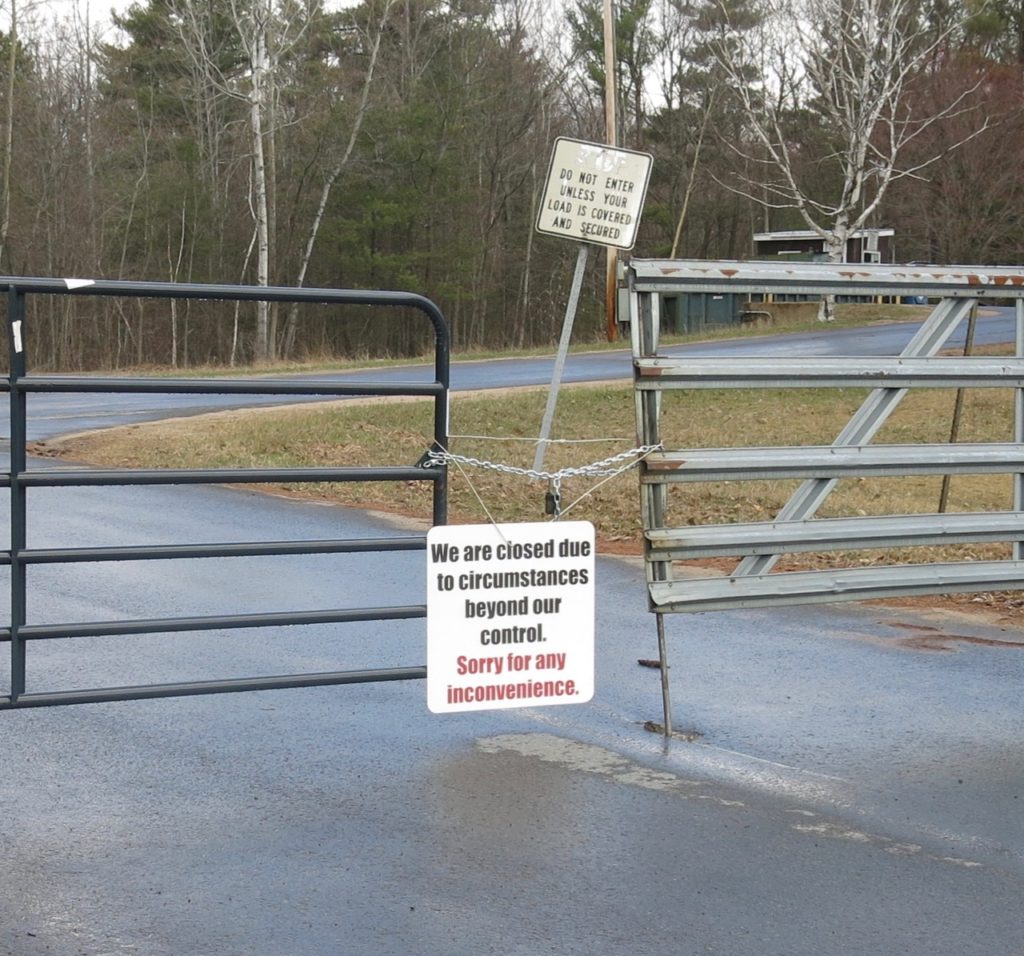
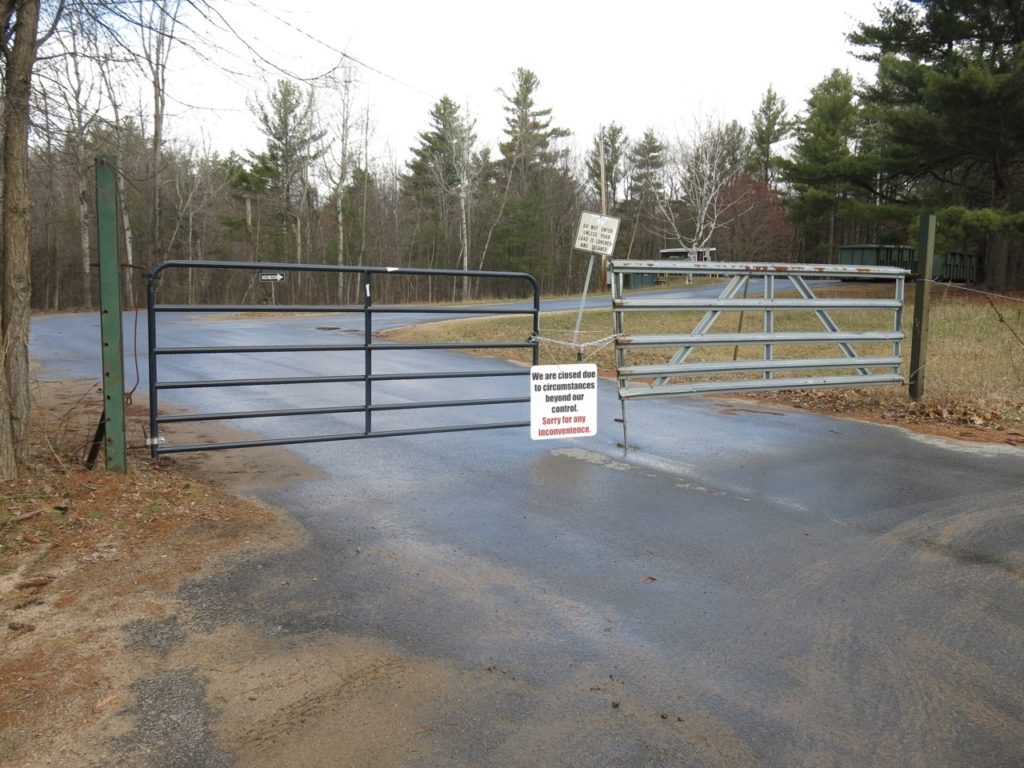
The Barney Downs Road Convenience Station is closed today (Saturday, April 28, 2018) for an unexplained reason.
Posted: April 28th, 2018 under Environmental News, Peru News.
Comments: none
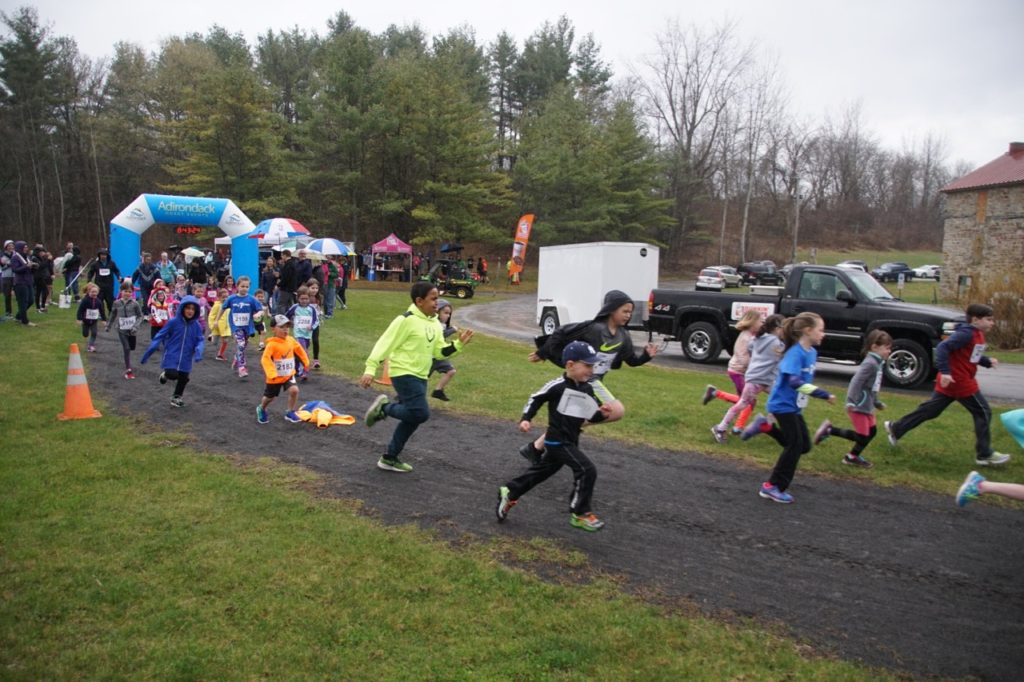
Peru, NY – In spite of rain showers there was a good turnout this morning for the inaugural Peru PTO Peru Pride 5k Run/Walk and Kids Fun Run at Heyworth/Mason Park. 142 runners/walkers signed up prior to this morning and more signed up today. All proceeds will benefit the Peru PTO playground replacement fund.
“The Peru PTO is excited to present this fun and healthy event to our community,” said Lindsey Wendorff, Peru PTO President. “We have a wonderful park and trail to showcase and this run will be a great way to enjoy spring and raise funds to benefit our Peru children.”
Click here to view more photos.
Posted: April 28th, 2018 under Peru School News, Youth News.
Comments: none
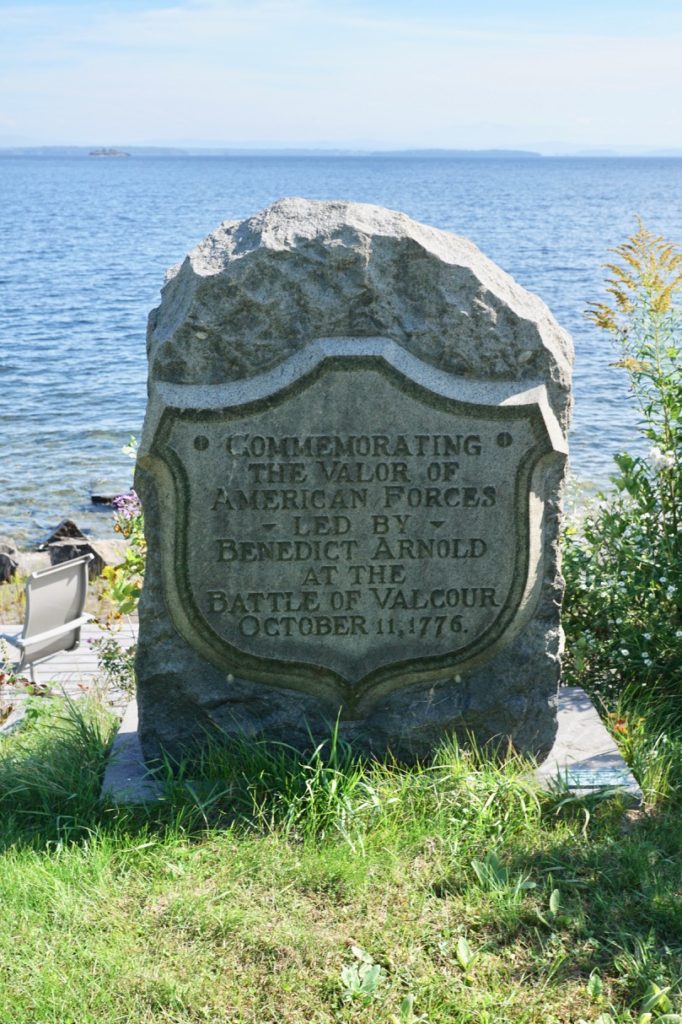
Valcour Monument on April 26, 2018
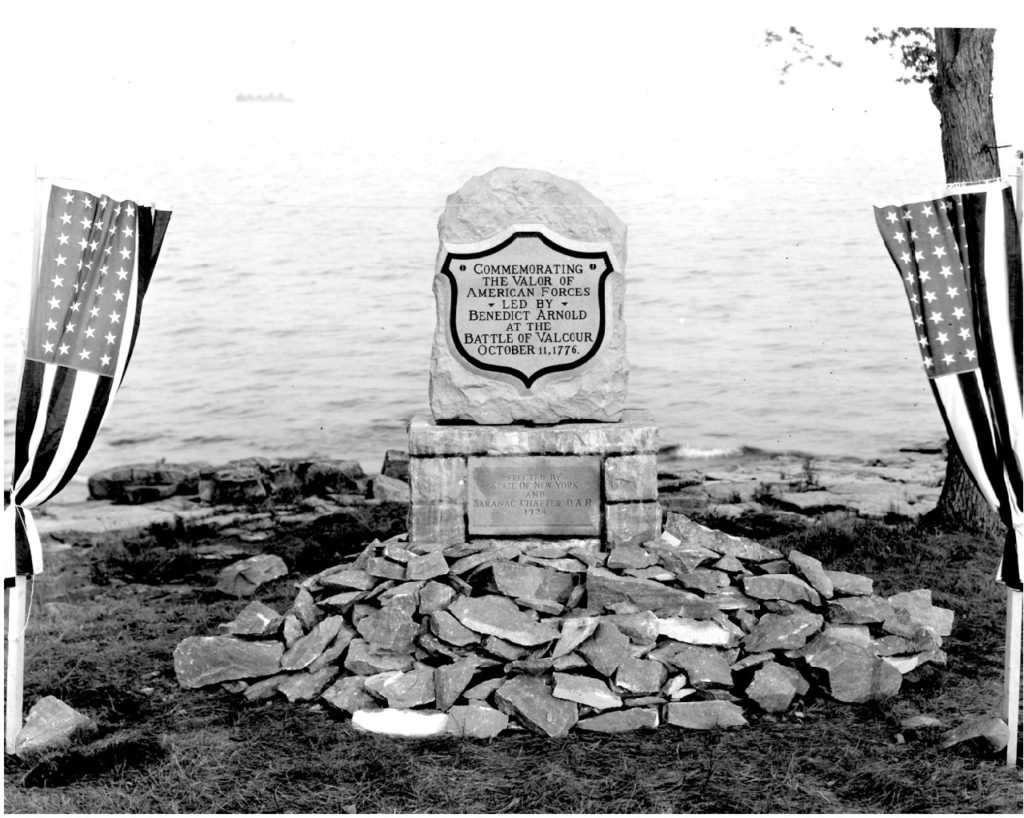
Valcour Monument on Dedication Day 1928
By John T. Ryan
Recent letters to the Press Republican Editor have made people aware of an ongoing debate within our local historical community. The debate involves a plan under consideration by the Saranac Chapter of the Daughters of the American Revolution (DAR) to relocate a monument that commemorates the valor of American forces led by Benedict Arnold in the Battle of Valcour on October 11, 1776. The Valcour Monument, erected in 1928 and property of the DAR, is currently located in the Town of Peru adjacent to Route 9, 1.2 miles south of the Peru Boat Dock entrance road.
At the Peru Town Board’s September 11, 2017 meeting Town Historians Ron and Carol Allen informed the Town Board that the DAR is considering moving the monument to Clinton Community College, far removed from the battle scene and in Town of Plattsburgh. In the course of writing this story, the Peru Gazette learned the DAR would prefer moving the monument to the Peru Boat Dock, 1.2 miles north of its current location, but still in the Town of Peru.The Board responded to the Allen’s presentation by passing a resolution asking the DAR to reconsider its proposal.
The Allens cited several reasons for not relocating the monument:
Contacted by the Peru Gazette, Sharron Bell, Saranac DAR Chapter Registrar, explained why the DAR plans to move the Monument.
Sharon Bell summarized the DAR position stating, “ The DAR favors relocating the Valcour Monument to the Peru Boat Dock; however, relocating it to Clinton Community College is an option. The College has indicated it would welcome the monument and the DAR conducts its annual commemorative services at the College. If New York State does not take action, the DAR will take action.”
Editor’s Note: The Peru Gazette communicated with the Department of Environmental Conservation’s Region 5 Office in Ray Brook to get an update on DEC plans. The specialist most directly involved in the matter referred us to a Public Affairs Specialist who did not respond to either phone calls or emails.
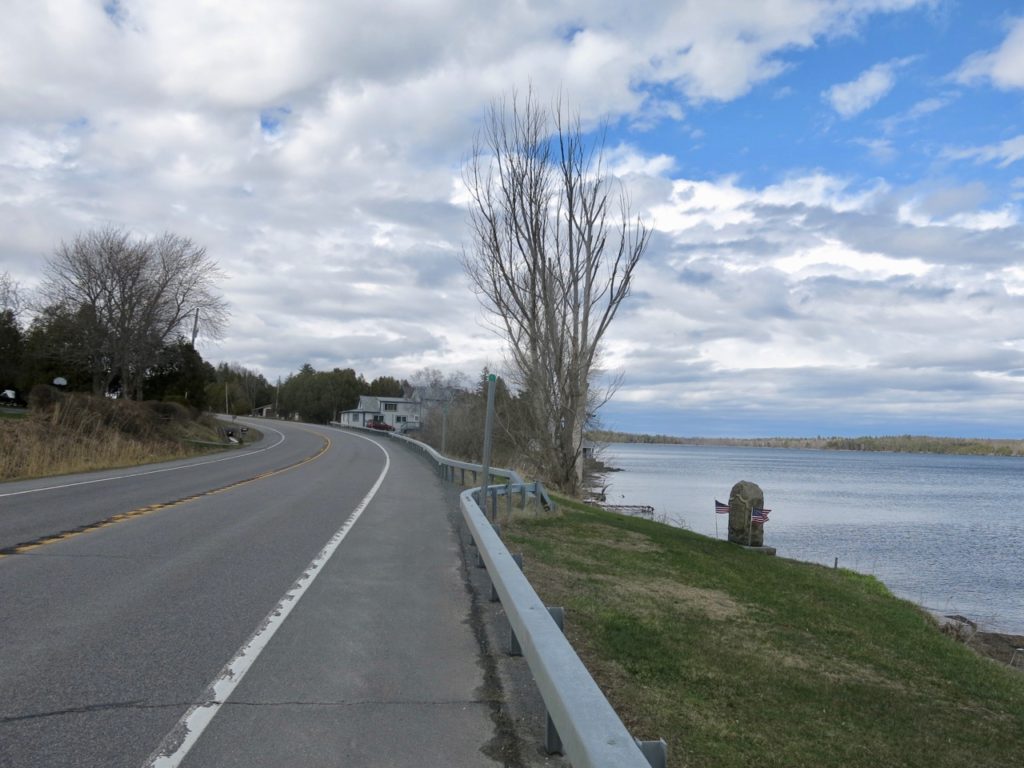
Rt. 9 to the north
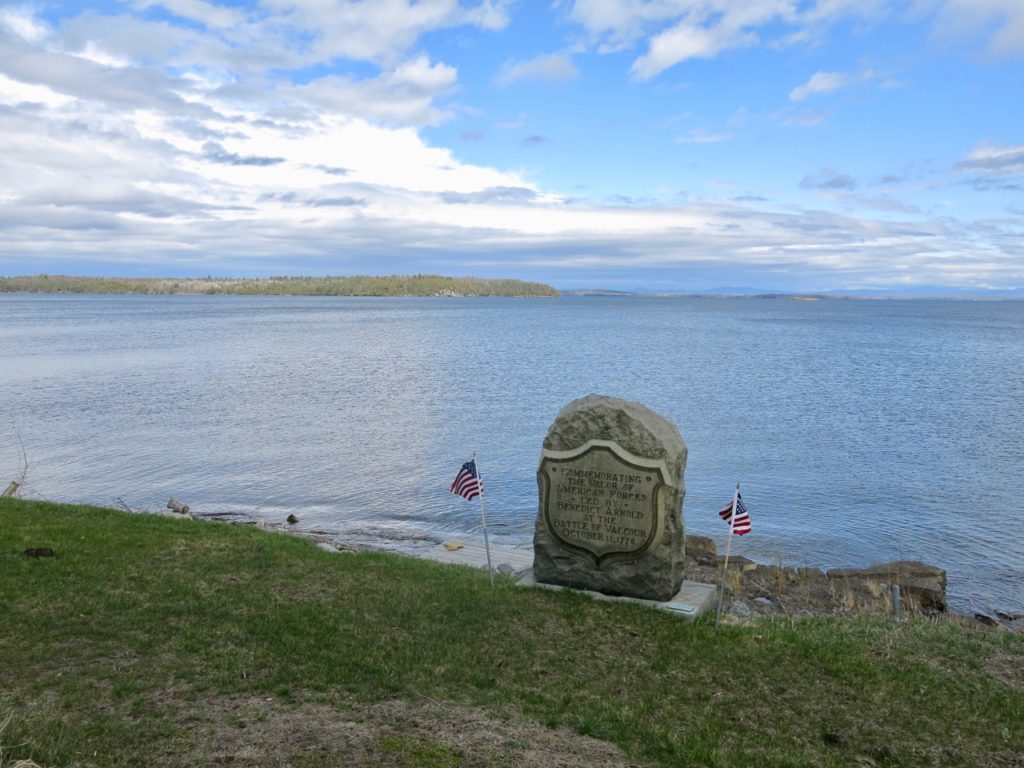
Valcour Island and battle scene
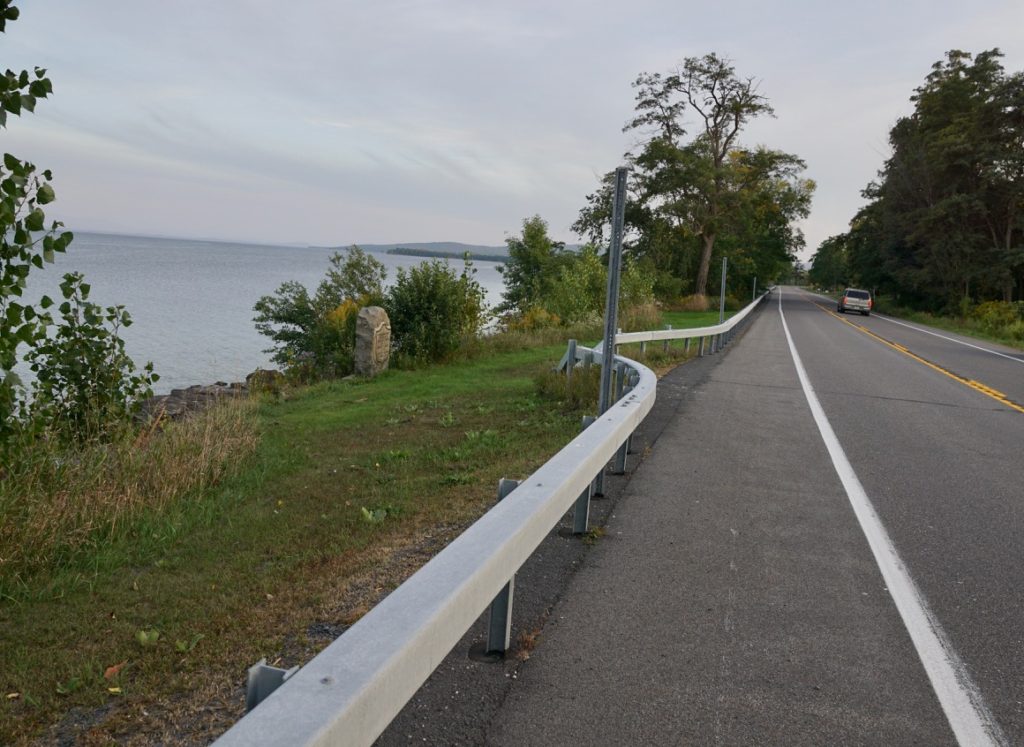
Pull-off Area
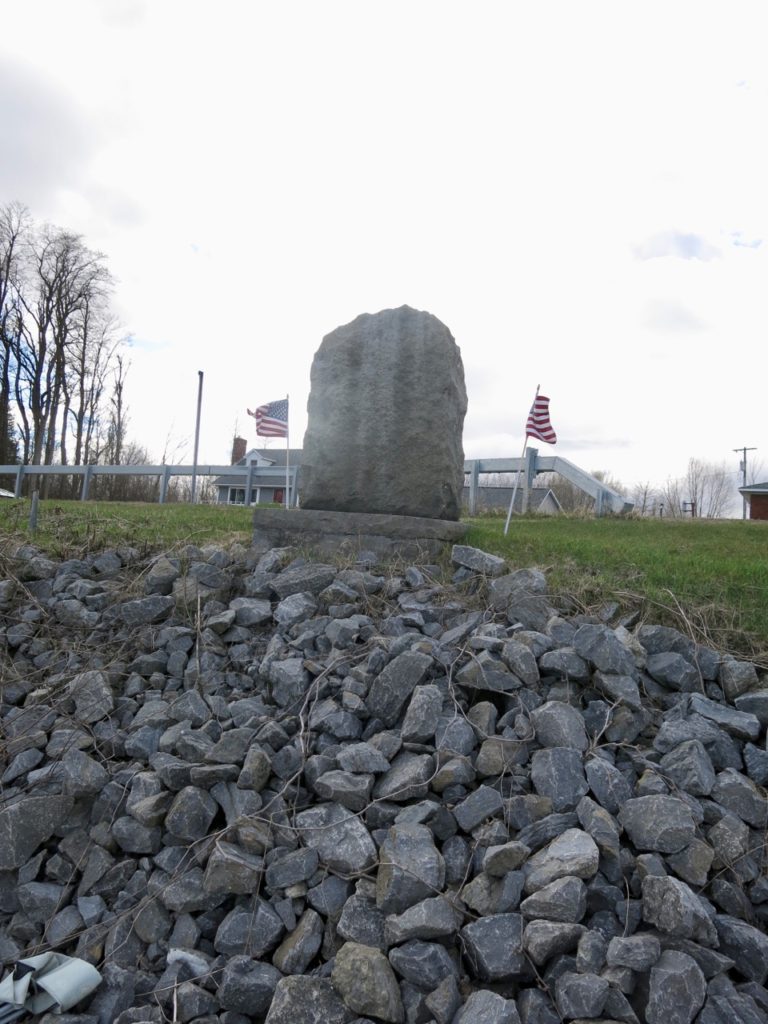
Reinforcing shock rock
Posted: April 27th, 2018 under Adirondack Region News, Peru/Regional History.
Comments: none
The Plattsburgh Rotary Club announces the 32nd Annual Rotary International Fishing Classic will be held on beautiful Lake Champlain Friday, June 1 to Sunday, June 3, 2018.
Cash prizes will be awarded to the 1st through 5th place fish (by weight) in three divisions: 1) lake trout, 2) walleye and 3) land-locked Atlantic salmon, steelhead or brown trout. First prize is guaranteed to be $2500 for each division, with other cash prizes to be determined by the cash pool. All winners must be present at the Awards Ceremony at the Naked Turtle in Plattsburgh at 3:30 Sunday afternoon. Plus, any registered angler who visits a weigh station during the Classic will be eligible to win up to $25,000 at the awards ceremony.
Fees are the same as last year; $50 each or $20 for anglers age 15 and under. Teams pay an additional $50 fee and may have two to four members (each registered individually) including a Captain (who will name all team members on his or her application.)
Anglers may register 1) online at plattsburghrotary.org – payment by credit card – before 5 p.m. on Thursday, May 31 2) on the toll-free “fishline” at 1-877-519-7942 – payment by credit card – before 5 p.m. on Thursday, May 31, or 3) by U.S. mail – check or money order made out to “Plattsburgh Rotary” or credit card – postmarked on or before Wednesday May 30. Read more »
Posted: April 27th, 2018 under General News, Northern NY News.
Comments: none

MAY 12-13, 2018 is Opening Weekend for the Babbie Rural and Farm Learning Museum. It will be open from 10 AM to 4 PM both days. There will be plowing and planting with antique farm equipment ongoing throughout the weekend. Other demonstrations include the granary, blacksmith shop and weaving (Kendra Durant). Work with a Master Gardener from Cornell Cooperative Extension to plant a flower for Mom and get answers to your gardening questions. Visit our new exhibits – Home Textile Production (spinning wheel and weaving loom) and Apple Orchard (apple grader, ladder, other antique equipment.). Take a stagecoach ride, ride Thomas the Train, stop and say hello to the animals. Visit the museum store.
Posted: April 27th, 2018 under Adirondack Region News, Peru News.
Comments: none
Posted: April 27th, 2018 under Peru News.
Comments: none
 Spring turkey season opens May 1 in all of upstate New York north of the Bronx-Westchester County boundary. With reproductive success below the long-term average in 2016 and 2017, coupled with harsh winter conditions this year, it is anticipated that the spring harvest will be down from last year. However, good hunting opportunities can be found throughout the state, particularly in regions with good nesting and poult success the last two years. The estimated turkey harvest for spring 2017 was about 17,500 birds.
View reports from DEC’s Summer Wild Turkey Sighting Survey
For more information about turkey hunting, see the 2017-18 Hunting and Trapping Regulations Guide or visit the DEC Website.
Posted: April 26th, 2018 under General News, State Government News.
Comments: none
Posted: April 26th, 2018 under Agricultural News, Environmental News.
Comments: none